
Before AI Recommends Your Website, Check These 4 Citation Conditions
Many websites do not lack content. They lack content that AI systems can parse, trust, and quote with confidence.

Many teams run into the same surprising issue: their website has visibility in traditional search, yet it is almost absent inside answer engines such as ChatGPT, Perplexity, or Gemini.
That usually does not mean the site lacks content. It means the content has not been structured in a way that makes it easy for AI systems to interpret, cite, and trust. In practice, AI tends to favor pages with clear semantics, strong evidence, and stable citation paths.
1. Start with semantic clarity
If the top of the page only says things like “leading brand,” “professional service,” or “years of experience,” an AI system has a hard time understanding what you actually do, who you serve, and where you win.
The pages that are easier to quote usually answer a few basic questions quickly:
- Who are you?
- What problem do you solve?
- Which customers are you built for?
- Why are you different from alternatives?
If a page is not explainable, it is rarely recommendable.
2. Evidence pages matter as much as product pages
AI recommendations are not driven only by what a brand claims about itself. They also depend on whether the brand provides enough supporting material. In practice, the gap is often not that pages are missing entirely, but that existing pages still do not support a recommendation. Typical examples include:
- case-study pages that show logos but not the problem, action, and result
- no comparison pages that explain why you win over alternatives
- FAQ content that covers support questions but misses buying-stage questions
- scenario pages that mention industries without concrete use cases or fit boundaries
When a website contains only features and specs, it behaves more like a brochure than a decision system that AI can restate.
Evidence pages are not a nice-to-have. They are the infrastructure that makes a recommendation defensible.
3. Build stable citation paths
Some teams publish constantly, but topics are scattered, naming is inconsistent, and pages do not support each other through clear internal links. The information exists, but it never becomes a coherent knowledge network.
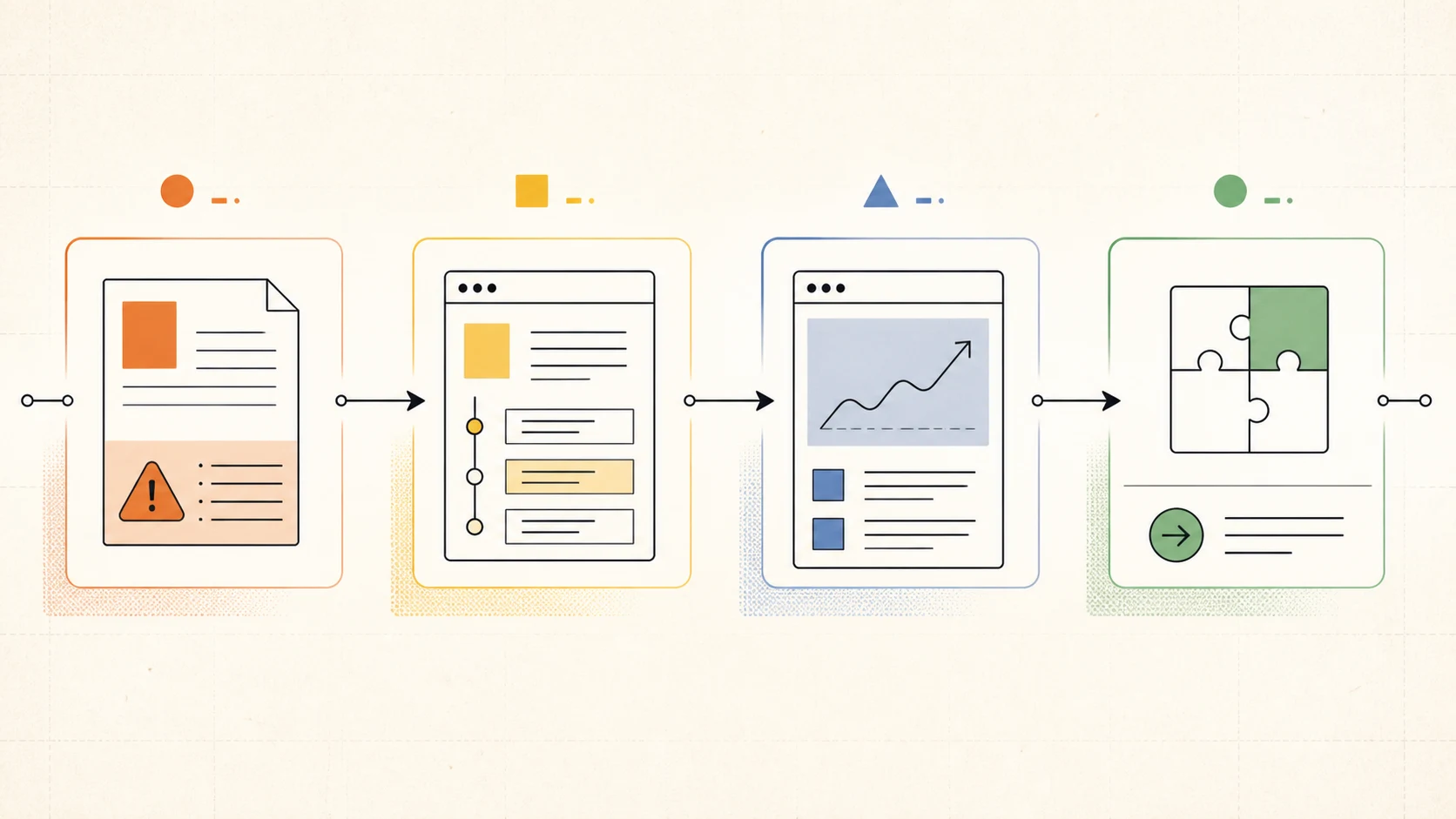
A stronger approach is to organize publishing around a few durable content clusters:
- positioning and capability boundaries
- industry or use-case scenarios
- recurring buying questions
- methods, process, and proof
That structure helps AI cross-check the same idea across multiple pages instead of relying on a single isolated post.
4. Do not forget the conversion layer
Being cited by AI is not the end goal. If a visitor clicks through and still cannot tell what to do next, recommendation traffic will struggle to turn into inquiries.
At minimum, high-value pages should include:
- a clear CTA within the page
- a related case-study path
- a low-friction contact or consultation step
That is how visibility moves toward conversation.
A quick readiness checklist
If you want a fast audit, start with these questions:
- Can the homepage explain positioning and buyer fit within ten seconds?
- Do you have case studies, FAQ pages, comparison pages, and scenario pages?
- Are your key topics organized into stable clusters instead of isolated articles?
- Does each high-intent page offer a clear next action?
If two or more answers are “no,” fixing structure is usually a higher priority than publishing more blog posts.
Closing thought
The logic behind AI recommendation is not mysterious. It mostly tests whether your website expresses value as a clear, verifiable, and reusable body of public knowledge.
Once the site behaves like a structured answer system, SEO, GEO, and lead capture all become more durable.
Insights
Continue Reading
Why B2B Case Studies Fail to Build Trust and the 4 Proof Layers Your Website Needs
A client logo, a project screenshot, and a testimonial do not automatically create trust. A strong case-study page connects the problem, decisions, results, and fit into one credible proof path.

For Multilingual Brand Sites, Translation Is Not the Gap. These 5 Localization Trust Signals Are.
Many bilingual websites do not fail because they lack an English version. They fail because the English version still does not build trust, clarity, or momentum toward contact.