
Before You Redesign a B2B Website, Audit Conversion First
If you do not know where visitors drop off, a redesign often just repackages the same problems with a cleaner surface.

Many redesign projects jump straight into visual exploration. But the biggest driver of performance is rarely the color palette, layout polish, or motion language. It is whether the page removes the right decision friction for the right visitor.
If that friction is never diagnosed, the redesigned site may look better without converting better.
First identify where users stop
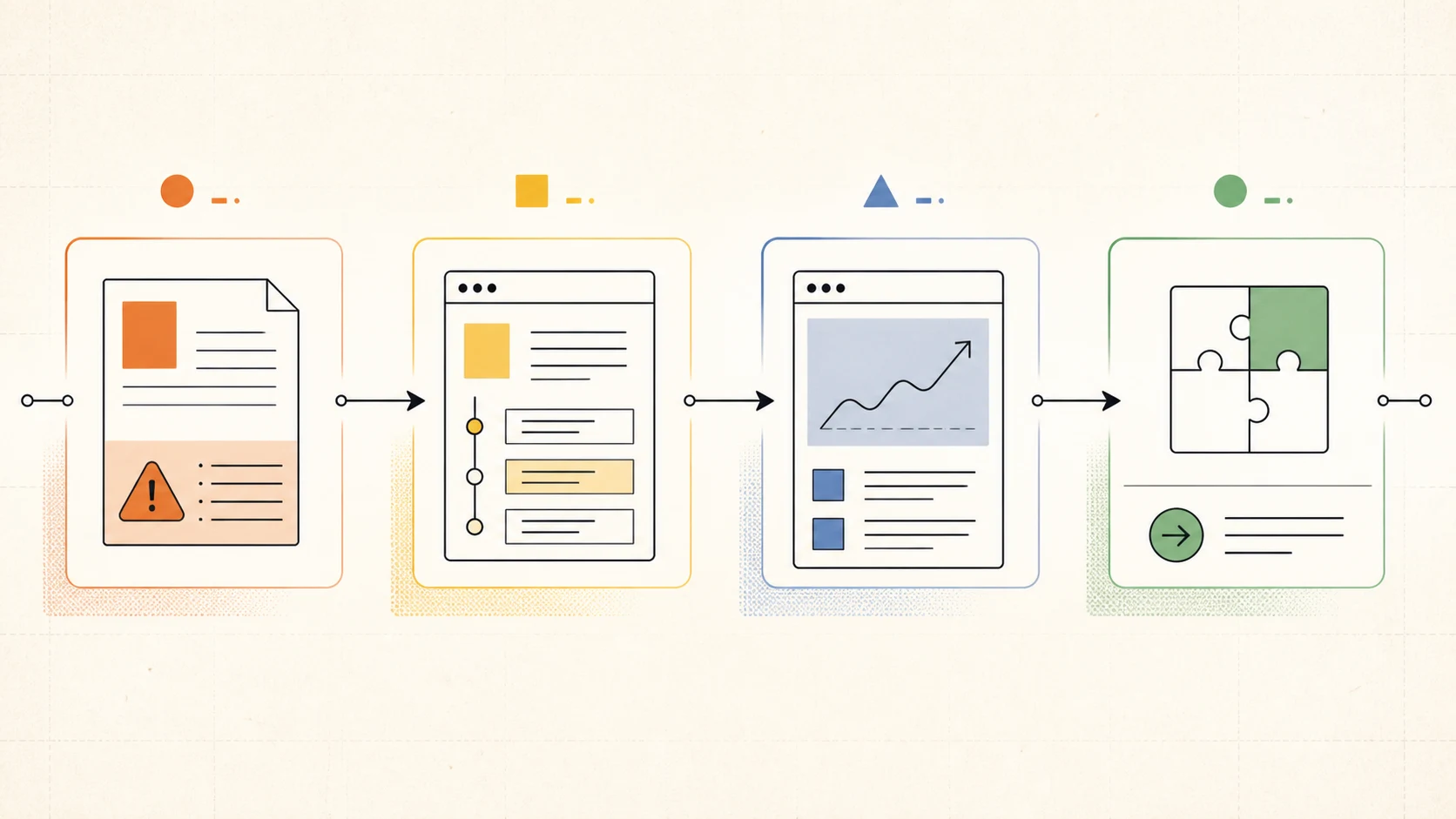
A simple audit method is to break the browsing journey into four steps:
- Do visitors understand what you do?
- Once they understand, do they trust that you can deliver?
- Once they trust you, can they tell whether you fit their situation?
- Once they see the fit, are they willing to take the next step?
If one step breaks, more design effort downstream often has limited impact.
Above-the-fold clarity is still the first test
The most common hero-section problem is not lack of information. It is vague information. Typical patterns include:
- vision without service clarity
- technical detail without business outcome
- broad claims without relevant use cases
The job of the first screen is not to explain everything. It is to help the right visitor decide whether this page deserves more attention.
Information architecture should follow decision order
Many websites are structured according to internal teams: about, products, contact. That makes sense internally, but it often does not reflect how buyers actually evaluate options.
A stronger conversion flow is usually:
- industry or use case
- solution and value
- proof and case studies
- FAQ
- CTA
That sequence maps better to real buying behavior and creates a smoother path toward contact.
Trust is not a slogan. It is a proof system.
When evidence is missing from the website, sales teams end up repeating the same explanations in conversations:
- who you have worked with
- what results were achieved
- why the proposed approach is credible
- what implementation effort looks like
The earlier those answers appear on the site, the less resistance users feel before reaching out.
CTA design should reduce action cost
Many pages technically include a CTA, but the CTA asks for too much too early. Pushing “book a consultation now” on a cold visitor is often too big a jump.
A better model is to support multiple levels of intent:
- high intent: book a call, request a proposal
- medium or low intent: view cases, subscribe, download a resource
That makes the site more capable of capturing demand at different stages.
Four conclusions worth locking in before redesign
Before visual design begins, the team should align on four things:
- What are the top three questions target buyers care about most?
- Is the current site weakest at clarity, trust, fit, or action?
- Which proof assets need to exist before the redesign can do its job?
- Which CTA paths should exist for different intent levels?
Once those answers are clear, design, copy, and development can move around the same conversion goal.
Insights
Continue Reading
Why B2B Case Studies Fail to Build Trust and the 4 Proof Layers Your Website Needs
A client logo, a project screenshot, and a testimonial do not automatically create trust. A strong case-study page connects the problem, decisions, results, and fit into one credible proof path.

For Multilingual Brand Sites, Translation Is Not the Gap. These 5 Localization Trust Signals Are.
Many bilingual websites do not fail because they lack an English version. They fail because the English version still does not build trust, clarity, or momentum toward contact.